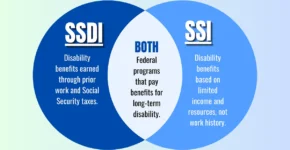
When someone in Philadelphia stops working because their health finally makes it impossible to keep going, they rarely remember it as a clean, single date. It is more often a slow collapse, missed days, reduced hours, jobs you try to save, and a point where you realize you cannot keep pretending. Then Social Security asks for one specific answer: “When did you become disabled?”
Many people reach out after a denial because they feel like the system rewrote their story. They gave an onset date that made sense to them, and Social Security treated their disability as if it began later. The truth is that an onset date is not just a personal timeline. It is a legal and evidentiary finding that must match what the record proves.
A Social Security Disability Attorney Philadelphia residents trust pays close attention to onset dates because this is often where eligibility, credibility, and future back pay begin to shift, sometimes quietly and permanently.
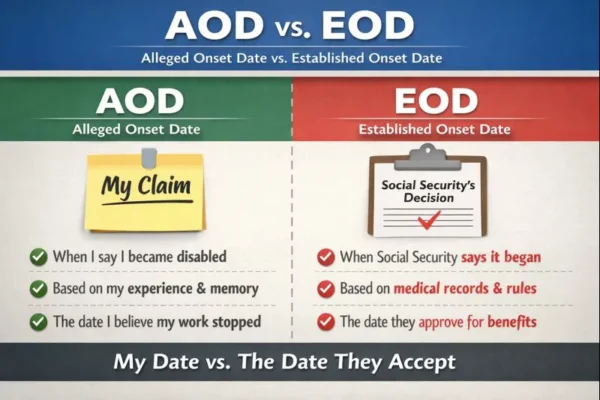
AOD vs. EOD: The Simplest Way to Understand It
Social Security uses two different onset dates, and confusing them causes unnecessary panic.
- AOD, Alleged Onset Date, is the date you claim your disability began. It reflects when you believe your condition stopped you from sustaining work.
- EOD, Established Onset Date, is the date Social Security accepts after reviewing medical evidence, work history, and eligibility rules. The EOD is the date Social Security uses to determine when benefits can start.
AOD is your claim. EOD is Social Security’s finding. Sometimes they match. Often they do not. When they do not match, it usually happens for reasons that feel unfair, but become predictable once you understand how Social Security evaluates disability claims.
Why Social Security Changes Onset Dates
Medical proof usually outweighs memory
Social Security does not award disability simply because a diagnosis exists. Disability is awarded when the record shows sustained functional limitations that prevent substantial work. If your records show the condition existed earlier but do not clearly document work-related limitations until later, Social Security may establish a later onset date.
This happens frequently because people keep pushing themselves. They work through pain, depression, fatigue, or cognitive decline until their ability to cope finally breaks down. In Philadelphia, this is common in cases involving back injuries, mental health conditions, autoimmune disorders, and progressive illnesses. The space between “I was sick” and “I could not sustain work” is where onset disputes are born.
Work history can create a hard boundary
If you worked after the onset date you alleged, Social Security may treat that work as evidence that you were not yet disabled, even if working came at a serious personal cost. The system often treats work activity as proof of capacity.
That is why details matter. Reduced hours, special accommodations, failed work attempts, and inconsistent attendance can change how Social Security interprets the timeline. A Social Security Attorney Philadelphia applicants rely on typically watches this issue closely because an onset date that conflicts with work history is one of the fastest ways for Social Security to move the EOD later.
Program rules can override what feels like the “real” start date
Sometimes Social Security accepts that your condition existed earlier, but eligibility rules still limit which months matter. For SSDI, insured status and waiting rules apply. For SSI, the application date can control eligibility in ways people do not expect.
That is why a disability claim can feel like it splits your life into categories. One date may be emotionally true, while another becomes the date that governs benefits under the law. An SSDI Lawyer Philadelphia applicants trust often explains this distinction, so people do not blame themselves for rules they did not know existed.
When “Earlier” Is Not Automatically Better
Many people assume that pushing the onset date as early as possible will always increase benefits. That instinct can backfire if the record cannot support it. A weak or inconsistent onset date can invite additional scrutiny, requests for evidence, or findings that limitations were not proven until much later.
A stronger onset date is usually the date you can prove clearly and consistently, not the date you wish the system would recognize.
What Helps an Onset Date Make Sense to a Decision-Maker
Without turning this into a checklist, onset dates hold up when three things align.
- The medical record shows a consistent pattern of functional limitations, not just diagnoses.
- The alleged onset date does not conflict with documented work activity.
- Descriptions of daily functioning match what the medical records already show.
This is also where preparation matters. Many people describe themselves as more capable than they are because they want to remain dignified or independent. A Social Security Lawyer Philadelphia residents rely on helps translate lived experience into the functional language Social Security evaluates, without exaggeration and without minimizing reality.
Why Onset Dates Shape the Rest of the Case
An onset date is rarely just about the past. It influences how Social Security evaluates credibility, how medical evidence is weighed, and which months are even eligible for payment. When Social Security sets an onset date later than expected, it is almost always because of evidence gaps, work history conflicts, or program rules, not random decision-making. Understanding those reasons early gives applicants more control over what happens next.
At Weisbord & Weisbord, P.C., we often see that clarity alone reduces fear, frustration, and unnecessary self-doubt. Onset dates are among the most technical parts of a disability claim, yet among the most important. Getting them right helps the rest of the case make sense.