
When life turns upside down
Picture a 42-year-old warehouse worker in South Philadelphia who injures their back lifting heavy pallets. After months of physical therapy and mounting medical bills, they realize they can’t return to full-time work. Friends mention Social Security disability, but each website and forum seems to give different answers about who qualifies.
Do you need decades of work history? What if you worked part-time or took time off to care for children? And how does the process differ for low-income individuals? If you’re asking these questions, you’re not alone. Many Philadelphians are unsure whether they meet the legal standards for Social Security Disability Insurance (SSDI) or Supplemental Security Income (SSI).
SSDI vs. SSI: Two Separate Programs
The Social Security Administration (SSA) manages two disability programs:
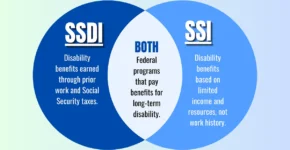
- Social Security Disability Insurance (SSDI) is an insurance program tied to your work history. If you’ve paid Social Security taxes, you build “work credits” that protect you against disability.
- Supplemental Security Income (SSI) is a needs-based program for people who are 65 or older, blind or disabled, and have limited income and assets. SSI’s federal benefit rate in 2025 is $967 per month for individuals and $1,450 per month for couples.
You cannot receive SSDI and retirement benefits simultaneously. If you are approved for disability, your SSDI benefit will convert to retirement benefits at full retirement age. SSI benefits stop if your income or assets exceed the strict income and asset limits.
How Work Credits Determine SSDI Eligibility?
To qualify for SSDI, you must be “insured” under Social Security. This means earning a certain number of work credits, which are based on your wages or self-employment income. In 2025, you earn one credit for every $1,810 in earnings, and you can earn a maximum of four credits per year. In most cases, you need 40 credits, with 20 credits earned in the ten years immediately preceding your disability (the 20/40 rule). Younger workers may need fewer credits:
- Before age 24:six credits earned during the three years before disability.
- Ages 24–31:credits for roughly half the time between age 21 and when disability began—for example, if you become disabled at 27, you need 12 credits (three years of work).
- Age 31 and older:at least 20 credits in the 10 years before disability.
If you stop working for too long, you may lose your insured status. Self-employed individuals earn credits based on their net self-employment income.
What about SSI?
SSI does not use work credits. Instead, you must meet financial limits: countable assets of $2,000 or less for individuals ($3,000 for couples) and a limited monthly income. Certain assets, such as your primary residence and one vehicle, are excluded. SSI may be a lifeline for people who never worked or who have not earned enough credits for SSDI.
What counts as a disability?
SSA uses a strict definition of disability. You must have a medically determinable physical or mental impairment that prevents you from engaging in substantial gainful activity (SGA) and is expected to last at least 12 months or result in death. SSA evaluates disability through a five-step process:
- Are you working? If your monthly earnings exceed the SGA limit—$1,620 for non-blind individuals and $2,700 for blind individuals in 2025—SSA assumes you can work and will deny your claim.
- Is your condition severe? The impairment must significantly limit basic work activities such as lifting, standing, or remembering tasks.
- Is your condition on SSA’s Listing of Impairments? Some conditions automatically qualify if they meet specified criteria.
- Can you perform your past work? SSA assesses whether you can do the job you performed in the past despite your condition.
- Can you adjust to other work? SSA considers your age, education, and work experience to determine if you could do a different job.
SSA does not pay benefits for partial or short-term disabilities. Conditions must last at least 12 months or be expected to result in death.

Special rules: blindness, trial work, and SSI assets
- Blind applicants: The SGA limit is higher—$2,700 per month in 2025.
- Trial work period: If you receive SSDI and attempt to return to work, you can earn up to $1,160 per month for up to nine months in a 60-month window without losing benefits.
- SSI asset rules: Countable resources must remain under $2,000 ($3,000 for couples); certain assets like your home do not count.
Why talk to a Social Security lawyer early? — Disability Attorney Philadelphia
Applying for disability benefits isn’t just about filling out a form. Many applicants are denied because they misunderstand eligibility requirements, apply before they have enough work credits, or fail to document their limitations. An experienced Social Security lawyer in Philadelphia can:
- Explain whether you should apply for SSDI, SSI, or both.
- Review your work history to see if you have enough credits or if your coverage is expiring.
- Gather medical records and coordinate with your doctors to produce detailed statements.
- Advise you on how part-time work or self-employment may affect eligibility.
- Guide you through the complex paperwork and deadlines.
Q & A: Key eligibility questions
Do I need 40 credits if I’m younger?
No. If you’re under 24, you may qualify with just six credits earned in the three years before your disability. Individuals aged 24–31 typically require credits for approximately half of the time between age 21 and the onset of disability.
Can I work part-time and still qualify?
Yes, but your earnings must remain below $1,620 per month (or $2,700 if blind).
What if I never worked?
You may qualify for SSI if you meet the disability definition and your income and assets are below the SSI thresholds.
Can I apply if my condition isn’t on the SSA’s list?
Yes. SSA will determine if your condition is as severe as a listed impairment by examining your functional limitations.
Clarity Leads to Confidence
Understanding SSDI and SSI eligibility can alleviate some of the stress you feel when illness or injury ends your working life. By learning how work credits, income limits, and medical criteria interact—and by seeking guidance from a knowledgeable lawyer—you can put yourself in the strongest position to secure benefits.
Let our one case – one lawyer approach ensure that you receive the individualized attention you deserve.
Related posts:
 SSDI vs. SSI: Understanding the Difference Between Social Security Disability Programs
 What Is the 5-Month Waiting Period for SSDI?
 Working While Applying for or Receiving Social Security Disability in Philadelphia
 Why Was My Social Security Disability Claim Denied? Steps You Can Take in Philadelphia — Disability Attorney Philadelphia
