At Weisbord & Weisbord, we know that childhood SSI uses a different evaluation lens than adult disability. Instead of assessing work ability, the Social Security Administration (SSA) focuses on functional limitations across key domains, not just diagnoses. In our experience, the strongest claims align school documentation, evaluations, and treatment notes to provide a clear, consistent picture of a child’s daily challenges.
Understanding how the SSA evaluates the six functional domains, identifying the most probative school records, and anticipating common documentation gaps are essential steps for proving a claim. For families navigating Philadelphia-area schools, specialized pediatric providers, and demanding therapy schedules, working with a Social Security Lawyer Philadelphia at Weisbord & Weisbord can help ensure the record reflects what daily life requires.
Understanding the Childhood SSI Standard with a Social Security Lawyer in Philadelphia
While the SSI program requires applicants to meet strict non-medical financial limits regarding household income and resources, the medical evaluation focuses entirely on the child’s daily functioning. To qualify for benefits, a child must have a severe, medically determinable physical or mental impairment that results in “marked and severe functional limitations.” If a child’s condition does not exactly meet the strict criteria outlined in the SSA’s Childhood Listings, the agency will evaluate whether the impairment “functionally equals” the listings by comparing the child’s abilities to those of unimpaired peers of the same age.
The Six Areas of Daily Life (Functional Domains)
The SSA uses a “whole child” approach, evaluating how a child’s impairments interact and limit their activities across six specific domains of functioning. To establish functional equivalence, the evidence must prove the child has an “extreme” limitation in one domain or “marked” limitations in two domains.
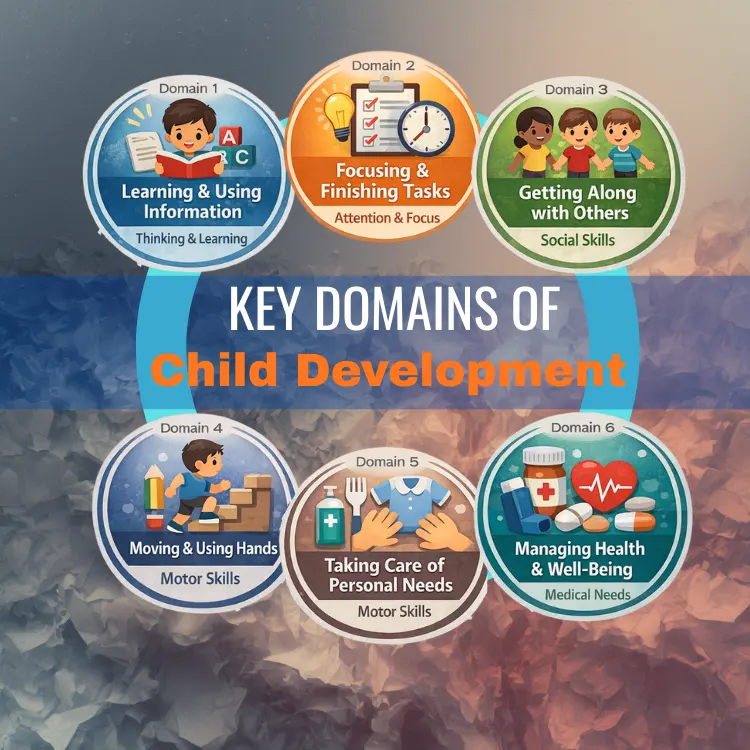
Domain 1: Learning and Using Information
A child’s ability to process the world around them is the foundation of their development. This domain evaluates cognitive function and academic readiness by measuring how well a child learns, understands new concepts, and applies that knowledge in practical, everyday settings.
- What it looks like at home: Having difficulty remembering simple directions given the previous day, struggling to grasp the concept of money, or lacking the vocabulary expected for their chronological age.
- What it looks like at school:An inability to keep up with grade-level reading or math, failing to comprehend verbal instructions from the teacher, or requiring significant repetition to learn basic academic concepts.
- Best record types:Psychoeducational testing, standardized achievement scores, IEP academic goals, and detailed teacher notes regarding reading and math comprehension.
Domain 2: Focusing and Finishing Tasks
Even a highly intelligent child will struggle if they cannot sustain their attention. This area measures a child’s executive functioning, evaluating their ability to initiate tasks, filter out environmental distractions, maintain an appropriate pace, and successfully finish activities without constant redirection.
- What it looks like at home:Frequently abandoning chores halfway through, being repeatedly distracted by background noises, or taking an exceptionally long time to get dressed compared to siblings.
- What it looks like at school:Needing constant verbal redirection from a teacher or paraprofessional, demonstrating profound off-task behavior, or being unable to finish timed classroom assignments.
- Best record types:Classroom behavior logs, therapist notes, parent reports, and Section 504 accommodation plans detailing the need for extra time or reduced distractions.
Domain 3: Getting Along with Others
Navigating social environments requires complex emotional regulation. This domain assesses a child’s social and emotional intelligence by examining how they initiate connections, cooperate with peers, comply with rules, and respond to criticism or conflict.
- What it looks like at home: Frequent physical altercations with siblings, severe oppositional behavior toward parents, or total isolation and an inability to form age-appropriate friendships.
- What it looks like at school: Disrupting the classroom environment, responding aggressively to redirection from authority figures, or struggling to cooperate with peers during group projects.
- Best record types:Behavioral Intervention Plans (BIPs), school disciplinary records, counseling notes, and psychiatric evaluations detailing social deficits.
Domain 4: Moving and Using Hands
Physical limitations can severely restrict a child’s independence. This domain captures the child’s physical and motor capabilities, encompassing both gross motor skills (such as walking and navigating spaces) and fine motor skills (such as using the hands and fingers to manipulate small items).
- What it looks like at home:Struggling to climb stairs safely, an inability to independently use utensils during meals, or a lack of coordination to button a shirt or tie shoes.
- What it looks like at school:Difficulty safely navigating crowded hallways, an inability to hold a pencil correctly for writing assignments, or requiring adaptive equipment in physical education classes.
- Best record types:Physical therapy (PT) notes, occupational therapy (OT) evaluations, and clinical records from pediatric orthopedic or neurological specialists.
Domain 5: Taking Care of Personal Needs
As children grow, they are expected to become increasingly independent in managing their own well-being. This area evaluates a child’s ability to maintain a healthy emotional and physical state, including using coping skills, recognizing when they need help, and performing age-appropriate self-care tasks such as dressing and hygiene.
- What it looks like at home:An older child requiring physical assistance with basic hygiene and bathing, engaging in severe self-injurious behaviors when overwhelmed, or lacking a sense of physical danger.
- What it looks like at school:Refusing to utilize coping strategies when frustrated, requiring aide assistance for toileting beyond a typical age, or an inability to self-soothe after a disruption in the daily routine.
- Best record types:Pediatric treatment notes, detailed caregiver observations, psychological evaluations, and nursing logs from the school.
Domain 6: Managing Health and Physical Well-Being
Chronic illness takes a generalized toll on a child’s body that extends beyond specific physical or mental tasks. Unlike the other domains that focus on specific abilities, this domain assesses the cumulative physical effects of medical impairments, such as chronic pain or fatigue, and the overall burden of their associated treatments.
- What it looks like at home:Frequent absences from community activities due to severe asthma attacks, profound daily fatigue resulting from seizure medications, or needing intensive breathing treatments multiple times a day.
- What it looks like at school:Falling asleep in class due to medication side effects, frequent trips to the school nurse, or chronic absenteeism due to hospitalizations or illness exacerbations.
- Best record types:Longitudinal visit history from specialists, therapy frequency records, medication side-effect logs, and school attendance printouts.
| Domain | What SSA looks for | Best supporting records |
| Acquiring and using information | learning and applying skills | psychoeducational testing, IEP goals, teacher notes |
| Attending and completing tasks | focus, pace, follow-through | classroom logs, therapist notes, parent reports |
| Interacting and relating | social behavior, regulation | behavior plans, counseling notes |
| Moving about and manipulating | physical function | PT/OT notes, clinical evaluations |
| Caring for self | safety, routines, regulation | pediatric notes, caregiver observations |
| Health and physical well-being | frequency and impact | visit history, therapy frequency, medication notes |
Which School Records Are Most Important?
Because the SSA evaluates these six domains by looking at a child’s day-to-day life, evidence from outside the doctor’s office is essential. For children, school is their primary workplace. Therefore, educational documentation is critical because school personnel observe the child over extended periods in structured environments and compare them directly with unimpaired peers.
- IEPs and School Evaluations:An Individualized Education Program (IEP) and the comprehensive Psychoeducational Evaluation Reports (ER) that precede it are foundational. These documents provide standardized test scores and detail the specific structured settings and accommodations a child requires to function, demonstrating that their academic survival depends on support rather than independent ability.
- Teacher Observations and Behavior Logs:The SSA places immense value on evidence from educational personnel. The Teacher Questionnaire (Form SSA-5665-BK), alongside daily behavior logs, allows educators to translate a child’s classroom struggles directly into the SSA’s functional domains, providing highly probative comparative assessments.
- Attendance and Disciplinary Records:Chronic absenteeism strongly corroborates the severity of conditions evaluated under the Health and Physical Well-Being domain. Similarly, disciplinary records, out-of-school suspensions, and incident reports provide objective evidence of marked limitations in a child’s ability to regulate behavior and interact appropriately with others.
School documents to request first:
- The most recent Psychoeducational Evaluation Report (ER)
- All current and historical Individualized Education Programs (IEPs) or Section 504 Service Agreements
- Completed Teacher Questionnaires (Form SSA-5665-BK)
- Behavioral Intervention Plans (BIPs) and detailed disciplinary records
- Comprehensive attendance records
Partnering with Weisbord & Weisbord for Your Child’s Claim
Securing SSI benefits for a child is a long-term commitment that requires a meticulous bridge between medical diagnosis and functional reality.
At Weisbord & Weisbord, we partner with Philadelphia families to ensure that the cumulative impact of a child’s condition is never minimized by administrative oversight. Under our “One Case – One Lawyer” philosophy, your family works directly with Karen Kress Weisbord, an attorney with over 40 years of experience who handles every technicality and evidentiary detail of your claim.
We meticulously review school IEPs and clinical notes to build a record that accurately reflects the daily support your child requires to navigate their world. If you need a Social Security Lawyer Philadelphia families trust for child SSI claims, our firm is prepared to guide you through the process with precision and care. We are here to serve as your advocate, providing the legal expertise needed to secure the stability and support your child deserves.
Related posts:
 Adult Function Report (SSA-3373): How SSA Interprets Your Answers
 Representative Payee Rules in Philadelphia: When Social Security Requires One and How to Change It
 Building Strong Medical Evidence for Your Social Security Disability Claim in Philadelphia
 Compassionate Allowances in Philadelphia: How SSA Fast-Tracks Severe Disability Claims
